.svg)
你所浪费的今天,是昨日死去之人苦苦奢望的明天;你所厌恶的现在,是未来的你再也回不去的曾经。把握住这七个字母,周而复始,珍惜你所拥有的每一天,才会拥有一个永无遗憾的生命!
welcome!
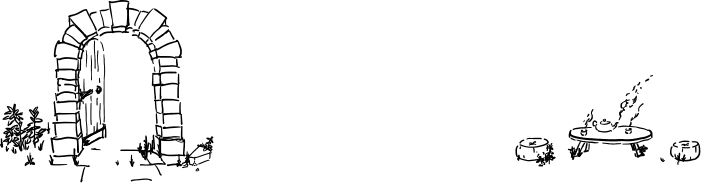
I’m Tang Bin-qiang. This is my little hypertext garden on the Internet — make yourself at home!
Currently, I’m exploring what agentic and communal technology looks like at Replit. How might we create infrastructures and technologies that empower the residents of the web to have access to the same tools as the architects?
On a broader level, I care deeply about creating spaces that enable others to have more agency: agency to ask questions without judgement; agency to do what they are intrinsically drawn toward; agency to play (because what’s the point if we can’t have a bit of fun?).
As far as ‘about’ pages go, I hope this acts as an open invitation into the many winding paths throughout this garden. Here are some places you may want to visit:
- The oak letter desk: a collection of my favourite writing;
- The hand-crafted workbench: craft I am proud of (websites, talks, workshops, projects, etc.);
- The bookshelf on the far wall: books that are in some state of read, being read, or to be read.
Here’s a well-structured English article you can use (suitable for blogging, practice, or sharing):

---

## The Power of Consistency in Achieving Success

In today’s fast-paced world, many people are constantly searching for shortcuts to success. They look for quick wins, instant results, and easy solutions. However, the truth is that real success rarely comes overnight. Instead, it is built through one simple but powerful principle: consistency.

Consistency means showing up every day, even when you don’t feel motivated. It means continuing your efforts even when progress seems slow or invisible. While talent and intelligence can provide an advantage, they are often less important than the ability to stay consistent over time.

One of the biggest challenges people face is losing motivation. At the beginning of any journey—whether it’s learning a new skill, starting a business, or improving health—enthusiasm is usually high. But as time goes on, difficulties arise, and progress becomes less noticeable. This is where most people give up. In contrast, those who succeed are the ones who keep going despite these challenges.

Consistency also builds discipline. Unlike motivation, which can fluctuate, discipline is something that can be trained. By repeating small actions daily, you gradually develop habits that become part of your routine. Over time, these habits require less effort, making it easier to maintain progress.

Another important aspect of consistency is the compound effect. Small actions, when repeated over a long period, can lead to significant results. For example, studying for just one hour every day may not seem like much, but over a year, it adds up to hundreds of hours of learning. This steady accumulation of effort often leads to mastery.

Moreover, consistency helps build trust—not only with others but also with yourself. When you consistently follow through on your commitments, you become more confident in your abilities. This self-trust is essential for taking on bigger challenges and achieving long-term goals.

In conclusion, success is not about doing something extraordinary once; it is about doing ordinary things consistently well. While the journey may be slow and sometimes difficult, the results are lasting and meaningful. If you focus on being consistent, you will eventually see progress—and that progress will lead you to success.

---

如果你需要:

* 更偏“技术类文章”(比如 AI / 编程)
* 或者“更高级词汇版本”(适合雅思/托福)
* 或者“短一点/口语一点”

我可以帮你再改一版 👍